Psychology of Luxury Consumption
Social Recognition & Status
The Psychology of Luxury Consumption
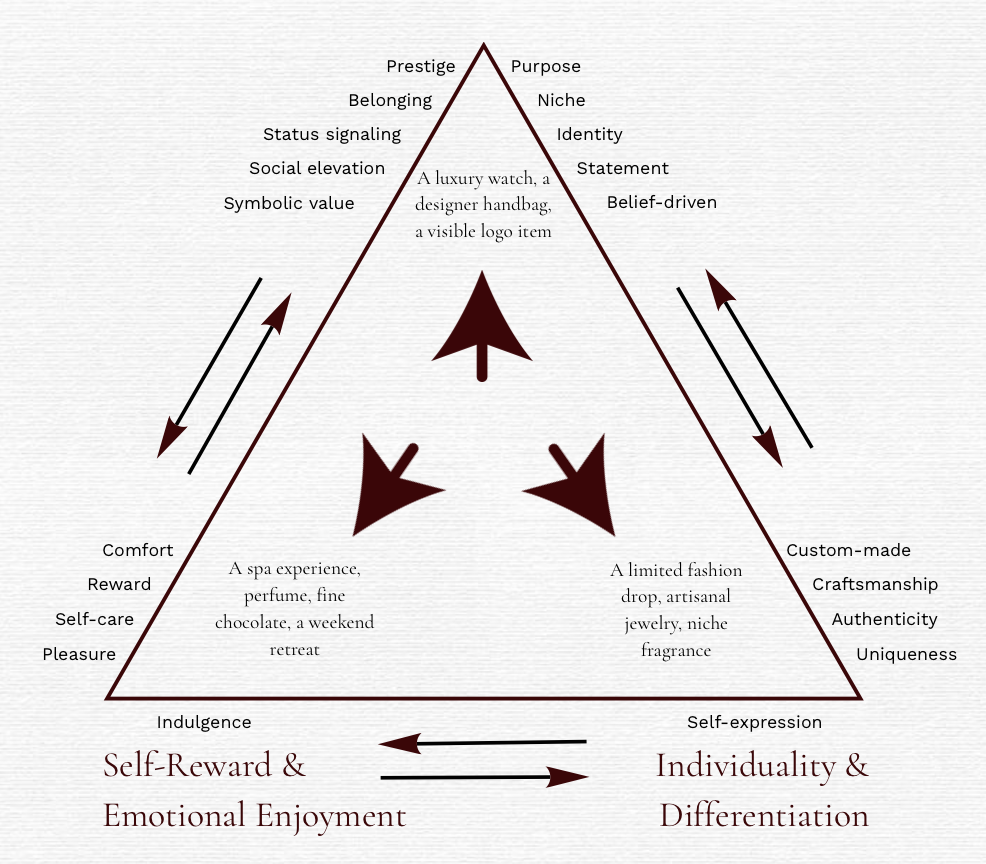
The model presented on the psychology of luxury consumption highlights the central psychological motives that guide consumers when purchasing luxury goods. It is based on a three-dimensional approach that interprets luxury not only as material possession, but as an expression of deeply rooted emotional and social needs. The three main motives are: social recognition/status, self-reward/emotional enjoyment, and individuality/differentiation.
1. Social Recognition & Status (top of the triangle):
Here, the desire for social visibility and belonging is at the center. Luxury products such as designer handbags, visible brand logos, or high-quality watches serve as status symbols. Consumption becomes a form of communication, it signals prestige, highlights social rank, and conveys symbolic value within a group. This is associated with motives such as status signaling, social elevation, and the need for belonging.
2. Self-Reward & Emotional Enjoyment (bottom left):
This area is characterized by hedonistic and pleasure-oriented motives. Here, luxury serves as a means of self-care, reward, or emotional balance. Typical examples include wellness stays, high-quality chocolate, or exclusive perfumes. Consumption is understood as a form of individual relaxation and emotional reward, independent of external recognition.
3. Individuality & Differentiation (bottom right):
In this motivational sphere, the expression of one’s own identity takes center stage. Consumers use luxury products to consciously distinguish themselves from the masses. Particularly relevant here are handcrafted one-of-a-kind pieces, limited editions, or products with a high degree of authenticity. Consumption becomes an expression of uniqueness, conviction, and personal attitude.
Dynamics and Transitions:
The arrows in the model illustrate that these three main motives cannot be strictly separated from one another. Rather, there is an interaction: a product can simultaneously convey status, provide emotional reward, and express individual values. The transitions between the poles are fluid, highlighting the multidimensional and psychological complexity of luxury decisions.
Conclusion: The model illustrates that luxury goes far beyond material aspects. Luxury is a psychosocial mirror, it reflects a person’s values, desires, and roles within their social and emotional context.
Read more about luxury and consumption in our other articles.

